
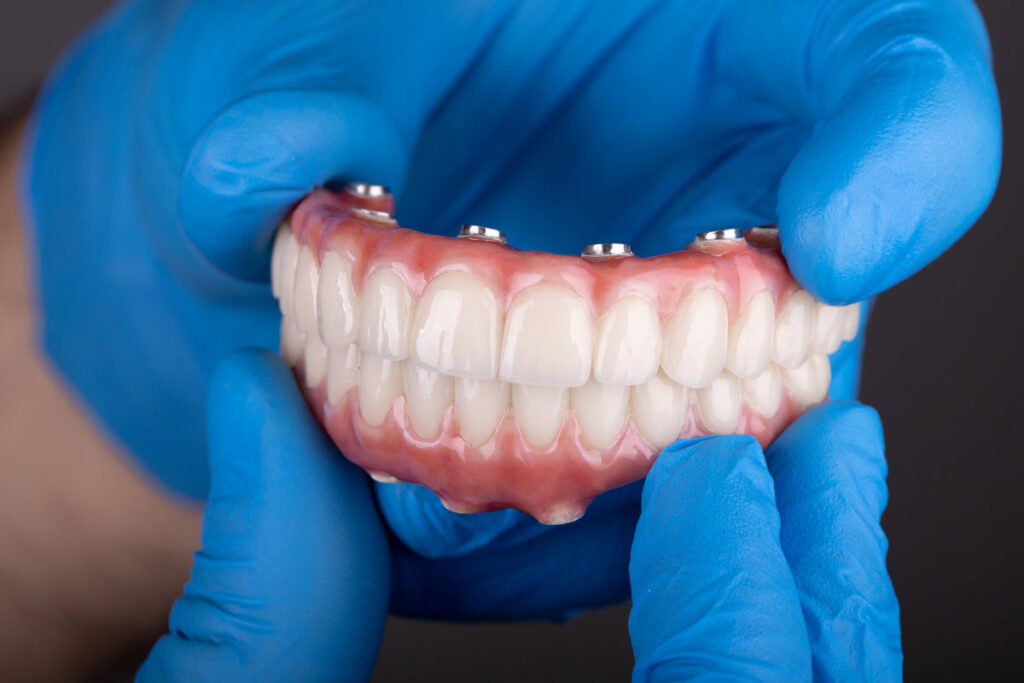
If you are missing most or all of your teeth, you have likely come across terms like All-on-4 and All-on-6 when researching your options. Both approaches use a set of strategically placed implants to support a full arch of replacement teeth, giving patients a fixed, natural-feeling result without the hassle of removable dentures. While the two treatments share a common goal, the number of implants used, the amount of jawbone required, and the ideal candidate profile for each option differ in meaningful ways.
At Lumiere Dental in Chicago’s Ukrainian Village neighborhood, Dr. Ryan Woitas offers full-arch implant solutions as part of our dental implant center, combining advanced technology with a patient-first approach to help you find the right fit for your smile and your health. Understanding the distinction between these two options is a helpful first step before your consultation.
What Does the Number in All-on-4 and All-on-6 Actually Mean?
The number in each treatment name refers to how many implant posts are used to support a complete arch of prosthetic teeth. These implants are surgically placed into the jawbone, where they fuse with the bone over time to create a stable foundation.
With All-on-4, four implants anchor a full row of teeth. Two implants are placed vertically near the front of the jaw, while the other two are angled toward the back. This angled placement allows the implants to engage more available bone and often makes it possible to avoid bone grafting procedures. With All-on-6, six implants are placed across the arch, typically in a more evenly distributed pattern. The additional two implants provide a broader base of support, which can be especially beneficial in the upper jaw where bone density tends to be lower.
How Do the Two Treatments Compare in Terms of Stability and Load Distribution?
Both All-on-4 and All-on-6 provide strong, stable support for a full arch prosthesis. The difference lies in how the biting forces are distributed across the jaw.
With four implants, the prosthesis is anchored at fewer contact points, which works well in the mandible where bone tends to be denser. All-on-6 spreads that load across two additional anchor points, reducing the pressure on each individual implant. This can be advantageous for patients who grind their teeth, have higher bite forces, or need a restoration in the upper arch. Patients considering same-day dental implants should also know that both full-arch options may be eligible for immediate loading protocols, meaning a provisional set of teeth may be attached on the day of surgery in appropriate cases.
What Factors Does a Dentist Consider When Recommending One Over the Other?
No two patients have the same jaw anatomy, bone quality, or oral health history, which is why a thorough clinical evaluation is essential before either procedure.
Some of the primary factors Dr. Woitas evaluates include:
- Current bone density and volume in both the upper and lower jaw
- Whether bone grafting has been performed or may be needed
- The location of the restoration (upper versus lower arch)
- Bite force and any history of bruxism
- Overall health and healing capacity
For some patients, imaging with cone-beam computed tomography (CBCT) helps provide a detailed three-dimensional view of the jawbone, allowing for precise implant planning. This technology is one of the tools we use to tailor treatment to each individual’s unique anatomy.
How Long Do All-on-4 and All-on-6 Restorations Last?
With proper care, both treatments are designed to be long-lasting solutions. A longitudinal study published in the Journal of the American Dental Association followed 245 patients over up to 10 years and documented sustained outcomes for the All-on-4 approach in the lower jaw. Similar long-term data continues to build for both configurations across different patient populations.
Maintaining the health of the surrounding gum tissue and bone is critical to the longevity of either restoration. Regular dental visits, routine cleanings around the implant attachments, and proper at-home hygiene all contribute to a lasting outcome. We provide detailed guidance on caring for your full-arch restoration so you can protect your investment over the years ahead.
Schedule Your Implant Consultation at Lumiere Dental
Dr. Ryan Woitas is a member of the American Dental Association and the Illinois State Dental Society, and has completed over 100 hours of continuing education with a focus on implant and restorative dentistry. Our full mouth reconstruction services reflect our commitment to providing comprehensive, personalized care that goes beyond simply replacing teeth.
Whether All-on-4 or All-on-6 is right for you depends on your specific anatomy and goals, and we are here to help you understand every detail of the process. To get started, contact our office to schedule a consultation with Dr. Woitas.